
Author Q&A: The Blazekeeper of Bowmore House by Elizabeth de Veer | Sea Crow Press

Reimagining Cinderella on the Edge of the Sea: A Conversation with the Author of The Blazekeeper of Bowmore House
At Sea Crow Press, we are drawn to stories rooted in place: stories where landscape and emotion are inseparable, where the natural world shapes not only the setting, but the soul of the narrative. The Blazekeeper of Bowmore House is one such novel: a luminous, atmospheric reimagining of Cinderella set along a fictional Scottish coast of windswept hills, crumbling houses, and restless seas.
In this conversation, we explore how this haunting coastal environment transforms a familiar fairy tale into something deeper, more introspective, and powerfully human.

I had an image of a young woman seeking her place in the world and searching the landscape for clues about her past and her future.
1. What drew you to reimagine Cinderella in a coastal, atmospheric setting, and how did that change the story's emotional tone?
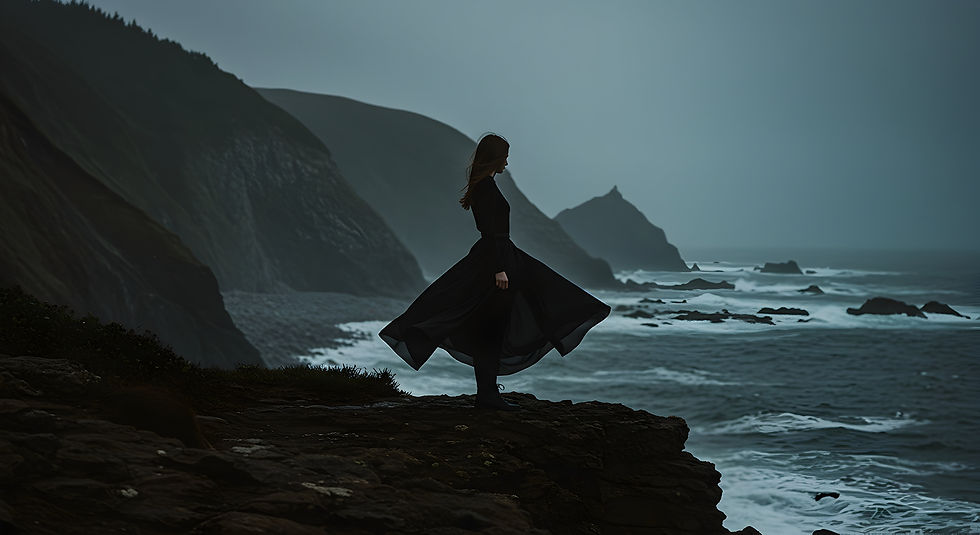
This story is set in a fictional version of the Scottish coast, a place with rambling hills and lots of castles. It's a place I love and it suited the fairy tale aspect, plus it gave me lots of ways to intersect weather, landscape and mood. The main character spends her free time at the coast, studying the horizon to find the small island where her mother's body is buried. I had an image of a young woman seeking her place in the world and searching the landscape for clues about her past and her future. I liked that sense of introspection.
2. Bowmore House feels steeped in mood and mystery. How did the coastal environment shape the narrative and your characters' inner worlds?
Bowmore House is the childhood home of Cinder, my main character, and it stands by the sea in deep disrepair. The house is basically dying, but it's all Cinder has left of her family. When those who remain in the house lose almost everything, Cinder accepts the role as primary caretaker for the house – she tends the fires around the clock because if they go out, the house will not sustain life and the house itself will die.
3. In your retelling, how does your protagonist differ from the traditional Cinderella, and what aspects of her story felt most important to reinvent?
My Cinder is a firecracker! Truly. She's a young woman coming into her own, trying to work out her place in the world. She's brave, smart, independent and feisty; she makes mistakes and provokes people. Some of the clashes she has with her family members – they never refer to each other as step-mother or sister, they are simply family – are caused by her actions. I wanted her to have opportunities to grow as a person. Cinderella as we know her from the 1950 Walt Disney movie is a lovely, billowing cloud of sweet perfection, like a dollop of whipped cream. I wanted to show a young person who was wrestling with the world and trying to figure out her own identity.
4. F.airy tales often hinge on transformation. How does transformation manifest in your version beyond the classic elements we expect?
When Cinder finds a letter her mother wrote while dying, Cinder learns her mother's story and this changes how she sees herself and every person in her life. She starts to understand that the way people appear to us in one moment and one circumstance might only represent one part of who they are. Eventually, the contents of the letter lead to a revelation that Cinder is not the lowly fire-tending orphan everyone thought she was. But in order for her to claim her new role, her (step) sister must point out that she deserves every good thing because of the person she is on the inside. From there, she can step into the person she's meant to be.
5. Instead of a traditional fairy godmother, what forces or figures guide your protagonist's journey?
I replace the fairy godmother with a mysterious character called Nula na-Nekon. I was fascinated by the midnight curfew imposed by the fairy godmother. In my story, Nula is the accidental midwife who delivered Cinder's mother, Ailen. Nula is made out of time and she seems to be a human constantly cycling through life stages, from infant to child to teen, to young woman, then all the way up to death and then starting over, all in a few seconds. She shows Cinder that life is full of mysteries and unseen possibilities.
6. Did you intentionally subvert any classic Cinderella tropes, and if so, which ones were the most satisfying to rework?
I was inspired to write this book after I saw the animated Cinderella movie with my young daughter. I had always loved that movie, but this time, it left me flat. Essentially, it's a story about a blended family of women living in isolation, one is perfect and beautiful, and three are ugly and jealous. But people are complicated; we have all kinds of feelings for all reasons. I wanted to show a family whose conflicts reflected each individuals' personality, experiences and grief. And in the end (spoiler alert) they are able to resolve the matters that divided them. Not so much happily ever after, but brought together for now.
I focused on the sensory experiences of the world I was creating, including time of day, angle of light, weather, and all the different ways the ocean looks and feels.
7. Atmosphere plays a huge role in this novel. What techniques did you use to create that immersive, almost haunting coastal feel?
First of all, thank you! I focused on the sensory experiences of the world I was creating, including time of day, angle of light, weather, and all the different ways the ocean looks and feels. Life by the sea, especially in a cold climate, can also be deeply isolating, so that adds to the moodiness as well.
8. How do relationships in your story, family, romance, or otherwise, evolve differently compared to the original fairy tale?
The original story, both the Charles Perrault and the Brothers Grimm version, are cautionary tales about the price of vanity and the benefits of being beautiful and kind. The Grimm version also has a vicious (and very bloody) revenge story. I wanted to feature a story about a family trying to withstand a challenging period. One of the biggest differences between my story and the traditional ones is that the sisters are not ugly or wicked – or consumed with jealousy. And in the end, they each stand up for their sister.
9. What does "happily ever after" mean in your version of Cinderella, and did you approach that idea differently?
People often criticize the myth of "love at first sight," regarding Cinderella and the Prince. The love story in Blazekeeper is actually the culmination of a long-time friendship. The animated movie suggests that everything in Cinderella's life will be sunshine and butterflies the moment she marries the Prince. But any marriage is the beginning of a new journey that has its own challenges. Blazekeeper concludes on the note of having resolved many unknowns for Cinder, and now she has a deeper understanding of her own identity. Because of that, she has the chance to start on a life of meaning, which is what she's been searching for since the beginning.
10. For readers who love fairy tale retellings, what makes The Blazekeeper of Bowmore House a unique experience within the genre?
I think fans of fairy tale retellings will love The Blazekeeper of Bowmore House because it includes all the magic but also the transformative energy of friendship, the wisdom of women, and the power of forgiveness. On top of that is a love story about a prince who would give up everything to be with the woman he loves, and a young woman coming into her power. I'm hoping it's the Cinderella story we're all looking for.
Author Q&A: The Blazekeeper of Bowmore House by Elizabeth de Veer | Sea Crow Press:
A legacy revealed. A shoe lost at midnight. A future rewritten.

Cinder has always longed for a life beyond her small world, preferring cliffs to ballrooms, and hen houses to throne rooms. Orphaned at eleven, she is raised by her stepmother, a woman weighed down by grief and secrets. But everything changes when Cinder discovers a hidden letter from her late mother—revealing royal blood, a legacy of betrayal, and a shocking truth: her stepmother may have once saved her mother's life.
Summoned by a lifelong friend who works in the king's stables, Cinder dares to defy her stepmother and attend the king's ball. Yet as she uncovers her true lineage, she must face a destiny far more dangerous and powerful than she ever imagined.
Set against a rugged, windswept coast, The Blazekeeper of Bowmore House is a lyrical reimagining of Cinderella's journey—exploring identity, the enduring love between mother and daughter, and an unbreakable bond of friendship.
Learn more about The Blazekeeper of Bowmore House and order your copy here.


